

Story Summary: An intergalactic cruise ship is damaged and resources are running dangerously low. (Scroll Down To Read)
Take the poll for this week’s story, “Leviathan”:
(It’s completely anonymous…and fun!)
“Resident Philosopher” Nalini’s take:
Nalini Jacob-Roussety ties simple questions to deeper philosophical frameworks! Listen to her discuss the poll question above. Comment in the discussion area at the end.
💡Paid subscribers help us publish stories like this every week and access our full archives.
📖 Weekly Short Story
📖 Email cut short? Read This Story on Substack

Leviathan by Jonathan Turner
After we killed the passengers, we put the bodies in one of the low-pressure, unheated storage compartments. Some people had wanted to have some kind of solemn burial-in-space thing; that was too ghoulish for most of us, though. Mostly the ones we killed had been volunteers, but a few had to be forced. I had had to kill one of them.
Afterward, I ran into Jenny Fenton in the lounge. She’s a tall black girl, an able spacer, real smart. I’d thought we might end up getting something together, but we were just friends. She bought me a beer.
“Rough?” she said.
“Yeah.” I took a big swig of beer to avoid giving her details. “I just hope it does some good.”
She ignored my implied question. “Come on, Vas, you know there was no other way. The lottery was fair, if that’s what you’re thinking.”
“I wasn’t thinking at all, actually.”
“So what else is new?” Gordon Yamaguchi sat down, which didn’t please me a lot. Ordinarily I liked him okay—not great, just okay—but he was good at being flip and sarcastic, and I wasn’t in the mood for it.
“Stow it, Gord,” said Jenny.
Gordon shrugged. “When you gotta go, you gotta go. Hell, most of them were triage cases anyway.”
“Some of them would have made it to Minerva,” I said.
“Yeah, dead, like the rest of us.” Gordon ordered a double Scotch, which made me think maybe he wasn’t as cool as he pretended to be.
I finished the beer. “Look, Jenny, what’s the deal? Are we going to have to do a second round?”
Jenny shook her head. “Sorry, Vas, I don’t know. They’re looking at the life support now, what’s left of it I mean, and trying to figure how much time we lost getting back on course.” She lowered her voice. “I probably shouldn’t tell you guys this, but it doesn’t look like we’re going to get our comms and detection gear back anytime soon.”
“Jesus,” said Gordon. “How are we navigating?”
“The old-fashioned way,” said Jenny. “Drop out of hype, look at some stars, measure some angles, crunch some numbers. That’s why it’s taking so long.”
I went back to my quarters, but I couldn’t sleep. The face of the passenger I had killed kept coming back to me. This passenger was an ordinary guy, about forty-five, graying hair, a little potbelly. I’d seen him, I think, but I never knew his name. He wasn’t the type you’d have expected to make trouble, but at the last minute he jumped me, screaming.
We didn’t have guns—who takes guns on a passenger liner?—so all I had was a big wooden billy club, made from an ornamental lamp that had been in the first-class lounge. Anyway, what scared me, thinking about it in my berth, was that I hadn’t hesitated. Not even a little. I don’t know what I had been thinking, if I was thinking at all. I remember what I did perfectly, but it’s like my brain was a total blank. I whipped that lamp around as hard as I could and got him smack on the temple. It sounded like someone crushing a plastic cup. He crumpled up, kind of sideways, and I hit him again. I could smell his blood.
I got up and wandered the corridors. The lighting was way down to save power, not that that was the worst of our worries. Some of the corridors had been sealed off to conserve air, though. I was in second class, and the corridors were like a motel—bland carpets, painted walls. Up in first class they were softly lit and paneled with wood; down in steerage they were bare, with pipes and conduits and exposed lights. That was where most of the colonists were, and where most of the civilian casualties had come from.
I had been walking just like this when the meteor hit us. The lights kind of wobbled, and the ship rang, like a gigantic bell. Nobody knew what had happened, but it didn’t seem like anything to worry about. We joked about it as we steadied ourselves. Someone was saying something about the captain getting nailed for DUI. We should have thought a little. The ship was a whale, an enormous thing; anything that could make it quiver was something to worry about.
I looked up and realized that I had made my way to sickbay. I pushed the door chime.
“Come on in,” said Doc.
Doc Li looked like a video doctor, and he had the manners, too: a little white-haired guy, who wore old-fashioned glasses and fussed a bit. He had made a big stink about crew being exempt from the lottery, and had tried to put his name in. I liked him a lot.
“Well, Vassily,” he said, “what brings you here?”
“Eh. Couldn’t sleep.”
“You want a pill? In your case it might be a good idea.”
“Nah.”
He didn’t say anything, just puttered around his office tidying things.
“Doc,” I said, “why did you make such a thing about the crew not being in the lottery?”
He looked at me over the tops of his glasses. “Bad precedent.”
“Isn’t it true what the captain said, about having had heavy crew casualties in the explosion and fires and needing every spacer to keep the ship running?”
“Oh, I don’t know. Probably.” He sat down on the edge of the bed. “But that’s not the point.”
“Well,” I said, “what is the point?”
“The point is,” Doc said, “it was handed down as a dogma. Not ‘people we need will be exempt,’ but ‘crew are by definition exempt.’”
I didn’t see what he was driving at, and my expression must have shown it.
“Look,” he said. “It went pretty smoothly today, right?”
“I had to kill a guy.”
“I know,” said Doc. “I’m sorry about that, Vas. God knows, every time I think about my medical supplies being used for—that—I get sick. You know, they wanted me to do the injections. I refused, said it would violate the Hippocratic oath. Which it would.”
“Anyway, what were you saying?” I still didn’t want to talk about it. “I guess it went pretty smooth. I mean, there was a little trouble, but not much.”
“Sure,” said Doc. “People knew that there wasn’t much choice. A lot of them were critically injured, some volunteered. But what happens if we find out—say, that we’re still short oxygen, or water, or something?”
“Well,” I said, “I guess we’ll have—we’ll have to have another lottery.”
“It won’t be as smooth,” said Doc. “And if we need a third or, God help us, more rounds—”
“Hell,” I said, “that won’t happen! I mean, if worst comes to worst and we do need to, um, do it again, they’ll be able to figure out how many need to go.”
“A minimum number, maybe.” Doc polished his glasses on his lab coat. “But we’re going to be making continual course corrections by dead reckoning. Which will slow us down, depending on how much fuel we use and how far off course we go. Anything that could happen, I mean anything unexpected, would be bad. Anything at all that breaks—the air, the water, the engines—will make it worse.”
“Jesus,” I said.
“Or whoever,” said Doc. “That’s why I think the crew should be in the lottery. Even if it’s just a token. Otherwise, it’ll make it an us-against-them thing later on.”
“Thanks a lot, Doc,” I said.
He looked at me with his old blue eyes, and I thought he looked sad. “Vas,” he said, “you’re a big, strong young man. If there’s another round you’re going to be tapped for enforcer again.”
“I think I’d better take that sleeping pill,” I said.
* * *
The pill gave me a headache the next morning, but I went to breakfast anyway. I mean, it’s a space liner. What are you supposed to do with yourself?
The cafeteria was crowded. I kept looking around, expecting it to seem empty, but it didn’t. I knew that we actually hadn’t had to sacrifice that many people, but everything seemed so damn normal. After a while I noticed it was real quiet, though. The people who were talking were mostly talking in mumbles. There were a few exceptions, like a guy I heard at a big table telling loud stories. It got me real ticked off at him, and I don’t think I was the only one.
There was no coffee, because of the water shortage. I had just finished eating when an announcement came over the PA, saying that there would be an assembly at 0900 and that everyone should watch or attend. I felt my stomach drop. The cafeteria got very quiet, and I heard a crash as someone dropped something. Then everyone started talking at once.
I picked up my tray to return it. While I was standing in line, someone tapped my shoulder. I turned around and saw a tall gray-haired guy wearing a jumpsuit.
“You’re Arkadieff, right?”
“Yeah,” I said.
“I hear you did a good job yesterday.”
We shuffled forward a step. “Look,” I said, “I don’t want to be rude, but who are you and what do you want?”
“Sorry.” He put forth a hand. “I’m Bill Johnson. Major, retired.” I shook his hand, juggling my tray of dirty dishes.
“Yeah, well, thanks, Mister Johns—Major Johnson, but, uh—”
“Relax, son,” he said, grinning with a set of very white even teeth. I didn’t mind Doc calling me “son,” but this guy kind of set me on edge. “I just wanted to compliment you. We’re going to need more cool hands like you soon.”
I almost asked him who “we” were, but by that time I was at the head of the line, and I didn’t want to talk to him anyway. I dumped my tray, muttered thanks to Johnson, and walked off before he could follow.
* * *
I always thought that Captain Barrington was probably chosen for his looks. I mean, normally the captain of a passenger liner is pretty much ornamental, right? The computers do all the work, and he just has to look good, like a game show host.
Captain Barrington looked good. He was tall, solidly built enough to look authoritative without being portly, and had a distinguished silver beard and moustache. He wore a long, old-fashioned-looking blue coat with rings around the arms and two rows of brass buttons down the front. His expression was calm—actually, it was so calm I wondered whether he wasn’t a little bit stupid.
The auditorium was in first class. There was a lot of expensive wood paneling and furniture, red cushions, big screens, sculpture, stuff like that. I saw a few other second-class passengers there, but no thirds. It didn’t take long for the crowd noises to die down after Captain Barrington got up on stage. He looked down at some hand-scribbled notes.
“Ladies and gentlemen,” he said, “I will be brief. We are navigating toward Minerva by dead reckoning. We shall probably arrive there in fourteen days. Unfortunately, damage to our life support systems is worse than we had first believed; we have suffered a continual slow leakage of oxygen and water. Therefore, it is my onerous duty to order, with heavy heart, another lottery. The drawing will take place at noon and the triage will follow at two o’clock.”
When he stopped, I released my breath. So did a lot of other people, I think. There weren’t any questions: I think everyone had pretty much guessed what was going on. I saw Jenny standing by the stage and tried to catch her eye, but she was avoiding me.
“If there are no questions—” said the captain.
“Hey, I gotta question!” This was from a loudly dressed woman in the front row. “What about the crew?”
“Madam,” said Barrington, “as I said yesterday, our crew casualties have been severe. Every spacer is needed to run the ship.”
“Oh, yeah?” She pulled out her tablet, punched up a gaudy brochure, and fanned it at him. “What about here where it says these ships practically run themselves? What about the part where we’re supposed to be safer here than at home in bed, huh?”
“I am truly sorry, Madam.” The captain really did look sorry, but not very sympathetic. “Accidents do happen.”
* * *
After the meeting broke up, I hung around outside the lounge, looking for Jenny. When she came out and saw me, she flinched.
“Look, Vas, I can’t talk now,” she said.
“Jenny,” I said, “I just want to know what’s going on.”
“I can’t talk, Vas, really I can’t. I’m on duty. Look, maybe later.” She turned sharply away from me and loped off down the corridor.
Later? I might not even be alive later. Yesterday I hadn’t been scared—it had all happened too fast—but I was scared now.
* * *
I wasn’t picked. But, like Doc said, they put me on the security team again.
I had a kitchen knife, and a piece of steel pipe from somewhere. I watched as the people shuffled into the little room. None of them looked at me. I kind of expected trouble, but to me it looked quieter than the day before.
The captain came by and made a solemn little speech, which I didn’t really hear. I was looking at the other security guys—all but two of us were men, and all of us were big and tough-looking—and wondering what they were feeling. A couple of them were looking around, too.
We didn’t say much to each other as the CPO dismissed us with more thanks. I went to Doc’s office.
He was busy there, him and his two assistants. They were the ones who had done the injections. There were about six crew members lying there, mostly bloody and ugly looking. Doc was operating on one of them.
“Doc,” I said, “what happened?” I probably shouldn’t have distracted him, but I didn’t think of that.
“Our first riot,” he said, not looking up. “Two isolated cases; the other guys got jumped by a bunch of victims who’d gotten together. God knows where they thought they’d go if they got away.”
“How did they do all this damage?”
“One of them had a knife,” said Doc. “A couple of the others had broken glass.” He finished what he was doing. “Close him up,” he said to one of the corpsmen. Hanging up his lab coat, he took me by the arm. “Come on, Vas, I need a drink.”
* * *
When we got to the lounge Gord Yamaguchi was already there.
“So,” he said. “The conqueror comes. Heil!”
I almost belted him one. Instead I pretended not to notice him and ordered a beer for myself and a bourbon-and-sake for Doc. I sat down at another table with my back to Gordon. Doc joined me.
“Oh, lighten up, Vas,” said Gordon. “You think you feel bad, how do you think they feel?”
I did hit him then. I’m a pretty big guy, and he wasn’t expecting it. There was an ugly spatting noise and a rain of blood: I got him right on the nose. It felt weirdly soft. He fell backward out of his chair.
There was a lot of yelling and shouting after that. I just stood there shaking, not paying much attention, kind of furious and sorry and totally stressed out. I remember Doc sitting on the floor examining Gordon. It was like I had tunnel vision.
Eventually Gord moaned, and I realized that I had been scared that he was dead. Suddenly I felt like I could move again, so I just shoved my way through the crowd. A lot of them threw me ugly looks. I heard a couple people mutter things like “goon” and “strong-arm bastard.”
I didn’t care, because I felt pretty rotten about it. But when I got to the door I was intercepted by Major Johnson, who patted me on the arm.
“I thought I was right about you,” he said. “I’ll be in touch.”
I shrugged him off and went back to my quarters.
When I got there, I went to get a glass of water and the second sleeping pill. Nothing came out when I pressed the faucet button, though. Instead the computer whistled.
“By order of the captain,” said a recorded voice, “water rationing is now in effect. Please report to Deck 17, Section C, to receive your allotment. Remember to bring picture identification. Thank you.”
So I went. It was an elevator lobby, but it felt like a ballpark where the home team is losing. There were a lot of people there, some grumbling, a few shouting. I was still pretty wired, so it didn’t make as much of an impression on me as maybe it should have.
Eventually I noticed a sort of line, like a crowd within a crowd, so I went and stood at the end of it. After a few minutes I was second from the front, behind a woman holding a baby. The petty officer at the head of the line took her name, asked for ID, checked his tablet, and handed her a one-liter bottle of water.
She stared at it. “What is this?”
“Ma’am,” the crewman said, “that’s your water ration for the next twenty-four hours.”
“It can’t be! Look, I have a baby—”
“I’m sorry, ma’am. I don’t have any orders about that.”
There were some loud grumbles from the crowd. “One liter?” the woman yelled. “I demand to see the captain. I demand—”
The guy turned up the amplifier on his tablet. “If anyone wants to help this lady,” he said, his voice booming over the crowd noise, “you can give her some of your own ration. That’s what giving her extra would mean, anyway.”
The crowd went real quiet. The woman got quiet too, and looked back at everyone. The people nearest her, who had been muttering support, looked down and shifted backward.
She didn’t say anything, but her face got all red and blotchy. She grabbed the bottle and marched away.
“Next?” said the petty officer. I stepped forward.
“Name?”
“Vassily Petrovitch Arkadieff.”
“ID?”
“ID?” I repeated. Then I remembered the announcement on the computer. “Jeez, I guess I forgot.”
The guy looked sharp at me. “Wait a minute. You were on the security team, right? Had a troublemaker yesterday?”
“Yeah,” I said.
He handed me a bottle. “Remember your ID tomorrow.”
“Hey!” yelled someone. “That’s no fair!”
I turned around. It was the guy who had been trying to be the life of the party at breakfast. He was a big fat guy with a big fat mustache. Probably if it had been someone else, I would’ve ignored it—actually, I was kind of vaguely thinking of finding the mother who’d been in front of me and sharing some water with her. But the fat man got on my nerves, and I just took my bottle and started to walk away.
It was more like swimming than walking. Everyone was shouting, and everyone was pushing. Nobody actually attacked me, but I was shoved pretty hard. I just put my head down and kept going. If we’d been outside, with rocks and stuff, I don’t know what would have happened. I looked up once, when I’d gotten to the outer fringe of the crowd, and the petty officer who’d been handing out water looked scared. He saw me, and gave me a look like he was wondering whether to try to use me as an enforcer. I don’t really like that sort of thing—people make all sorts of stupid assumptions about a guy my size—and the way the crowd was acting I thought it was a real bad idea, so I just got out as fast as I could.
I had thought the crowd in the lounge had been ugly, but this was a lot worse—not just sulky, they were mad. It wasn’t the same people, either. I was so busy thinking about it, wondering what was going on, that I never got a good look at the guys that jumped me.
There were three of them, I think. They were pretty slick about it: I walked around a corner and bam! one of them got me in the stomach with a club, while another one tackled me around the knees.
I went down. My head hit the deck, and I saw spatters of light. I almost threw up. It was hard to breathe. Meanwhile, the third guy had grabbed my water bottle, and the three of them lit off down the hall.
* * *
When I got to Doc Li’s office Gordon Yamaguchi had already left. I was glad of that. I told Doc what had happened, and he just grunted.
“Doc,” I said, while he fussed over me, “what’s going on? What’s happening?”
“There’s not enough to go around,” Doc said. He finished bandaging my scrapes and pushed me gently into a chair. “We’re all used to having enough of the basics, like food and water and air. Now that isn’t true anymore.”
“Yeah,” I said, “but why are people acting like animals?”
“We are animals,” said Doc. “We’ve got millions of years of evolution telling us how to fight for what we need when things get scarce. Remember the man you had to, um, deal with yesterday?”
“Kill,” I said. “I had to kill him.”
“Right,” said Doc. “You were threatened, you reacted. It was him or you. Your gut-level instinct told you that you and he were in competition.”
“You sound like what’s-his-name, Hobbes,” I said.
“Uh-huh. This is Hobbes’s vision of life without government—‘solitary, poor, nasty, brutish, and short,’” said Doc Li. “Maybe he was right. Nothing I’m seeing makes me want to disagree.”
I thought about it for a while. “It’s going to get worse, isn’t it?”
“I expect so,” said Doc. “If you want my advice, Vas, join a gang.”
“A gang?” I said. “Me?”
“Yeah, you,” Doc said, stabbing me in the chest with a finger. “You’re the quiet type, I know, but trust me on this. If things don’t stabilize, you’ll see us reverting to more basic kinds of social organization. That means tribes. Gangs. If you don’t have a tribe, you’ll be in trouble.”
“What about you, Doc?”
“I’ve got a tribe.” Doc’s expression was sour. “It’s the Crew Tribe, and I’m part of it whether I like it or not.”
I got up and walked around the office. “Jesus, Doc, why me? I’m nobody special. I grew up in the burbs, went to college, became an engineer, worked, decided to emigrate, someday I’ll get married and have kids. I didn’t ask for this. I’m just a guy.”
Doc shrugged, staying seated. “Most people are. In videos everything happens to capital-C Characters. You know, the Duchess and the Stockbroker and the Earnest Young Man all marooned in a lifeboat, or something. Real life isn’t like that. Almost everyone is just guys. Problem is, sometimes being just guys isn’t enough.”
* * *
I guess I really should have gone to see Gordon in person, but I couldn’t. I called from my bunk. When the tablet came on he looked pretty ugly, with a big bandage over his nose.
“Gord,” I said, “I’m sorry.”
He scowled at me, then smiled kind of sideways. “Hell, I guess I was asking for it, you know?”
“I’m still sorry,” I said. “I just lost it.”
Gordon shrugged. “Ah, no problemo. See you tomorrow.”
He flipped his screen off. I tried to rest for a while and couldn’t, so I pulled up some Mozart and listened to it over and over while I waited.
* * *
I went to the fancy restaurant for dinner that night; I figured I needed to blow some money to chill out. They were closed, though, so I ended up back down in the cafeteria. Doc had given me half of his liter of water, and I had that with me to drink.
It looked different. It took me a moment to figure out how. Instead of having people spread out all over the room, now people were gathered in little clumps with empty tables between them, like thick-walled soap bubbles. For a moment I didn’t see anyone I knew. Then I saw Major Johnson waving at me. I went over and sat down with his clump, mainly because I didn’t want to sit there eating alone.
“Arkadieff,” he said, shaking my hand, “welcome aboard.” His jumpsuit had been pressed so it had a vaguely military look, and he was wearing sunglasses, which I thought looked pretty silly on shipboard. There were a couple dozen men and women sitting at three tables—one of the largest groups. Major Johnson introduced me around, but I didn’t catch most of the names. There was a tough-looking little blonde woman called Babs and a burly dark guy called Mohammed and a pair of crew cut jock-types who were brothers. Everyone looked fit, and most of them looked aggressive.
“Now,” said Johnson, “we were just planning our strategy.”
“Strategy?”
“For the collapse,” said the blonde, Babs.
“Oh, right,” I said.
Johnson tapped on the table with a knife. “The key,” he said, “will be to ensure our access to the water distribution sites. The best method would be to set up a permanent perimeter nearby. Does anyone have a convenient cabin?”
“We’re half a ring away,” said one of the jocks.
“Excellent,” said Johnson. “In case of trouble, therefore, we’ll rendezvous at cabin 237-C2.”
At that moment I saw Jenny Fenton crossing the cafeteria with a tray. “Jenny!” I shouted, half-standing.
Johnson pulled me down. He was a lot stronger than he looked. “What’re you doing?” he hissed in my ear.
“She’s a friend of mine,” I said.
Several people at the table were giving me funny looks—everyone seemed to be doing that lately. “She’s one of the crew,” said Mohammed.
I remembered Doc talking about the “Crew Tribe.” “Oh,” I said. “I, um, I guess I wasn’t thinking.”
Johnson patted me on the shoulder—I was getting really tired of his touchy-feely style. “That’s OK, son,” he said. “We’ll handle it.” I guess he’d decided I was just another big dumb blond kid.
“Thanks, Major,” I said.
* * *
We went back to our quarters in a group. Not everyone was doing the same, but some were. We made the rounds of the cabins, dropping people off. I waited about an hour, then called Jenny.
“What is it, Vas?” she said when she appeared on screen. She looked tired and sloppy.
“I just wanted to talk to you, say hi,” I said.
“God,” she said, “that sounds so normal.”
“You look like hell.”
“I feel like hell,” said Jenny. “Vas, it’s not looking good.”
“What’s the problem?”
“Water, mostly. We’ve got the air supply stable and the engines are holding up OK, but there’s just not enough water.”
“Wait a minute,” I said. “There’s, what, a couple thousand people on a ship like this. There’s no way we carry enough water for that many people for a three-month voyage.”
“No,” said Jenny, “normally we recycle it—over 99% efficient, I think it is. But now the recycling gear is damaged, and we’re still not sure how bad it’s going to get.”
“What happened? Why isn’t it fixed? What are you people doing, screwing around—”
“Vas,” she said, “please, stop it. We had to fix the air supply first, otherwise we’d all be dead already.”
“Can’t you, I don’t know, cut the ration or something?”
“A liter a day is already minimum,” said Jenny. She rubbed her eyes, and for a moment I thought she was going to cry. “We’ve got three thousand liters left, and we use twenty-four hundred liters a day, and we lose a tenth of that because of the damaged recycling systems. You figure it out.”
It came to twelve and a half days, only it wasn’t even that good, because in three days we wouldn’t have enough for the daily ration. I swallowed, twice. “Does this mean that there’s going to be another, another—”
Jenny spread her arms wide, a helpless gesture. “Things are breaking down. Once we could have gotten away with it, maybe twice, but if this keeps going on—”
“Then why the hell are we doing it this way?” I said. I could feel myself sweating, and I thought of the water leaking out through my skin. “Why can’t we kill enough people so that everyone else is guaranteed to survive, just do it once?”
Jenny looked at me kind of sideways. “A couple of people have thought of that, Vas. What kind of margin of error do you want to leave? We don’t know what the minimum number of dead will be, so we’d have to kill a lot, say half the people aboard, though it’d probably turn out that most of them wouldn’t have died—”
“No,” I said, “stop, you’re right.” We both took deep, shivering breaths at the same time.
“Good night, Vas,” she said.
“See ya,” I said.
* * *
When I woke up the next morning my eyes were gummy, my mouth was like cotton, and my tongue felt like it was about three inches thick. I wanted to take a shower, but of course the water was off. I got dressed, feeling sticky and greasy. I could smell my own sweat.
I ran into a crowd in the corridor—a shoulder-to-shoulder ring of people, all leaning over one another on tiptoe to look inward.
“What’s going on?” I asked a guy near me.
“Couple bodies,” he said, ignoring me, craning his neck.
I did the same, and saw a bright red smear on the pale blue-gray paint of the wall. There were several of them, piled in the center of the corridor.
I caught the sound of Doc’s voice. “Everyone out of the way, please.” Most people moved, either because of his authority or because of the two ratings—big bruisers, bigger than me—who were with him. “Anyone see what happened?”
“I heard it,” said a woman. “My cabin is right there. They were drunk, they got lost.”
By this time I could see the bodies, Doc kneeling beside them. They were elegantly dressed, probably first-class passengers. They looked like they had been beaten to death, but one of them had a knife wound that was dribbling blood.
“There were some other people passing by,” the woman continued. “I think they were third-class passengers. The drunks started yelling at them, and they yelled back, and then there was, like, a lot of banging and smashing and screaming. And then it stopped and someone said, real nasty, ‘That’ll teach you, you bastard.’ And another voice said, ‘Fewer mouths to feed.’ And then someone else came and started screaming and everyone must have run away.”
Doc looked like he was only half listening. “Mm hmm,” he said. “Dead about half an hour.” He looked up and caught my eye. “Like I told you,” he said.
* * *
Just as I got back from breakfast (rationed) my tablet pinged. White letters crawled across a black background. No meeting in the auditorium this time, just an announcement of the lottery. Following the instructions, I logged into the central server.
I hadn’t been selected. I let out my breath, and realized that I’d been scared. Worse than scared, I’d been practically blind with terror. I could replay the last minute or so of my own thoughts in my head: I was saying “Please, God, no, not me, anyone but me.” Over and over and over.
The tablet chimed at me again. “Yes?” I asked.
It cleared to show the petty officer who’d recognized me yesterday. “Arkadieff,” he said. “Report to the collection station at 1100 hours for security detail.”
“No,” I said. I hadn’t planned on saying it, but it felt right. It was the first thing that had felt right that day.
His face took on a frozen, stupid look.
“Mr. Arkadieff,” he said, “maybe you don’t understand.”
“I understand, all right,” I said. “I said no. I’m not going to do it.”
“Mr. Arkadieff, it’s your duty—”
“Maybe,” I said. “I don’t know. Maybe it started out being a duty. But I’m not going to be an animal, okay? If I’m going to die, I may as well die like a human being.”
“Very well, Mr. Arkadieff.” I could see he had no idea what I was talking about, but his pupils got very small, and he grinned at me. I read once that smiling evolved from a threat display—bared teeth.
“In that case,” the guy continued, still smiling, “I’ll have to take notice of the fact that you obtained water without proper ID yesterday. You’ll be docked today’s ration to make up for it.”
Blip, the screen winked out. I sat down on the narrow bed and wondered what I’d done, but I wasn’t sorry.
Someone pushed the door chime. “What?” I asked.
“Vas, let me in.” I opened the door and saw Gordon Yamaguchi there. He was rumpled and pasty-white, his face almost as pale as the bandage on his nose; his breath came in little gasps, and it felt hot against my arm.
“Gord, what’s going on?”
“My number, Vas,” he said. I could see white all the way around his irises. “My number came up. They’re going to kill me, man.”
I just stood there and dithered for a moment.
“God damn it, Vas,” said Gord, his voice rising, “this is your fault! They’re taking the injured, you bastard, you broke my nose—Oh, God—”
Two big guys in spacer fatigues, maybe the two I had seen earlier with Doc, had rounded the corner. They were walking with an easy saunter, and they wore identical dull, uncaring expressions. They had steel pipes in their hands.
“It’s no good, Gordon.” I felt very calm and very quiet. “They can track you anywhere on the ship.” His face crumpled, and I knew that he knew it already.
So I half-stepped back into my cabin, groped around, hauled out the steel pipe that had been my weapon yesterday, and shoved it at him. I couldn’t tell you why I did it. Something about fairness, maybe.
Gord grabbed the pipe. His face didn’t light up, exactly, but there was life in it. He turned and ran down the hall, wheezing and holding his side.
The two ratings paused by my door. One of them smacked his pipe into his hand. “We’ll talk to you later,” said the other one. His expression never changed and his voice never wavered.
I watched them go down the hall, thanking God that I wasn’t with them.
* * *
I stayed shut in my room. I watched the ship’s bulletin board on the tablet. A couple people were posting descriptions, and it sounded pretty ugly. Within a few minutes it turned into a full-blown riot, and most of the victims got away.
As things were winding down, I saw a big notice appear with Major Johnson’s name on it. When I opened it up, it was a public announcement that any attempt to grab further victims from Johnson’s gang “will be met with force,” or something like that. There was also an appeal for people to come join him. I figured he was looking for serfs to do the scut work while he and his buddies lived out their commando fantasies.
Seeing the notice reminded me that I was supposed to be in touch with them. Also, I had started to think that my cabin wouldn’t be a healthy place to be when those two thugs came back. I went out into the corridor, looking both ways.
I half expected to see burn marks and screaming rioters, but it was all quiet there. Much quieter than normal, actually. I walked through the corridors to 237-C2, feeling twitchy the whole way, and hardly saw another soul. When I did pass other people in the hallways—mostly they were traveling in groups—we edged around each other, sliding along the walls. We all smiled a lot.
There was a barricade set up in the corridor when I got where I was going, furniture grabbed from the staterooms and public areas. Babs, the tough blonde, was standing on top of it in a classic heroic-soldier-defender-of-the-Motherland pose, a kitchen cleaver in her hand. When she saw me her face wrinkled up, like she wanted to spit.
“What’re you doing here?”
“Major Johnson said to rendezvous.”
She did spit, then. “Major Johnson don’t want no weaklings here.”
Johnson himself appeared behind the flimsy barricade. “What’s—oh, you.” He put on a sad expression. “Arkadieff, I thought better of you. Refusing to do your part to maintain order, helping runners—” He shook his head sorrowfully.
I shrugged. “That’s okay.” It’s hard to explain, but that’s exactly how I felt. I didn’t want to be part of Johnson and his little comic-opera goon squad, I didn’t care what he thought of me, I wasn’t scared any more. I guess Johnson must have seen that, because he looked really baffled when I turned and walked away from him. Babs and a couple of others yelled insults after me, but I didn’t really notice.
* * *
I ended up in Doc Li’s office. Jenny was there. When I came in, she got up and hugged me and gave me a kiss.
“You did good,” she said.
“Does everyone know about this?” I asked.
“It’s all over the ship,” said Doc. He lifted a glass. “I’ve liberated some booze from the lounge, for medicinal purposes. Here’s to humanity.”
I took a glass and joined him. “That’s the thing,” I said. “I mean, we’re animals, sure, but we’re people too, and we can make a choice. God, I guess I sound stupid.”
“I think you’re doing fine,” said Jenny.
We all drank for a little while.
“What now?” I said at last.
Doc put on his sour look. “At this point, the problem of killing enough people to save the rest of us looks like it’ll take care of itself.”
“Depending on how long it takes us to get to Minerva,” said Jenny. “Even a little glitch in the star positions can add a day onto the trip.”
“Come on,” I said, “don’t they have equipment for that?”
“This is a passenger liner,” said Jenny. “Things like this just don’t happen. Probably in the future they’ll pass a law requiring all ships to carry manual astrogation stuff. Like lifeboats on the whatchamacallit, the Titanic.”
Something else hit me. “Jenny, why’s food being rationed? Don’t tell me we’re short on supplies.”
“No,” she said, “we’re short on water.”
“Huh?”
“We don’t keep stored food, Vas, you should know that. We keep the basic materials on hand and synthesize the food to order, and that takes water.”
“A normal human uses about two liters of water a day,” said Doc, “but you don’t drink that much—most of it you absorb from food. Seventy percent of food is water.”
“Even, like, a steak?” I asked.
“No,” said Doc, “obviously a watermelon has more water in it than, say, a loaf of bread. Hell—”
He paused. I think we all had the same thought right then.
“What about a human body, Doc?” I said.
“A human body is about half water.” Doc put down his glass very slowly. “I don’t know how much you could recover. But you could get some. Hell, you’ve got five liters of blood, and that’s half plasma, and plasma’s mostly water.”
“We’ve got, let’s see, three hundred corpses,” said Jenny. “Say you could get just, what, a tenth of their mass in water, that’s maybe six kilos a person, that’s six liters, total eighteen hundred liters.”
“Almost eight days,” I said.
* * *
Well, obviously, since I’m talking about it, it worked.
Doc had to figure out how to thaw out those frozen bodies, neutralize the chemicals that had been used to kill them, and extract the water. Captain Barrington came down and assured everyone that there would be no more killings, and they were able to restore some sort of order. We didn’t tell anyone where the water came from.
We made it to Minerva with water to spare.
Of course, there was a big media circus when the word got out. They put Captain Barrington on trial. There was a lot of testimony about precedents from lifeboats and people stuck on mountain tops. The jury acquitted Captain Barrington, and he thanked them, and then he went home and put on his uniform and shot himself. Maybe he wasn’t as stupid as he looked.
I’ve seen Jenny Fenton a few times since then, but we never really got together. I mean, what could we talk about? I do keep in touch with Doc Li, though. He’s the one who thought I should write this down. He said maybe it’d help me.
See, here’s what bothers me. I’m an engineer. I like to solve problems. We solved the problem on the liner—we got here alive, and we didn’t have to kill any more people. But solving the problem didn’t fix anything. We still did horrible things to one another, and we still became less than human, and figuring out a clever way to get more water didn’t change that.
I’ve thought a lot about whether Hobbes was right. I guess what I think is that if we want Hobbes to be wrong, we have to make a conscious choice to make him wrong. Otherwise...well, the guy I killed, on the first day—I’ll see his face for the rest of my life. And I know that next time, it might be me getting hit with the lamp, and it might be you swinging it.
Discussion Questions (Leave a comment!):
Do you agree with the choice the captain made, to kill people on the ship by lottery? Or, do you think there was a different, better choice?
Doc says that as things get worse, people will naturally break up into gangs (or tribes). Do you agree? Does resource scarcity cause tribalism? Does income inequality or differences in economic opportunity cause tribalism as well?
Do you think as resources get scarce, that social norms must always break down and give rise to more animalistic nature? Are humans just animals at heart?
If you were in the position of the narrator, would you have continued to agree to being a part of the security detail?
Do you think as the narrator says, that in order to remain human we must make a conscious choice to be human? Will a sufficient amount of resource scarcity always make that choice impossible, or can people remain human to the end?
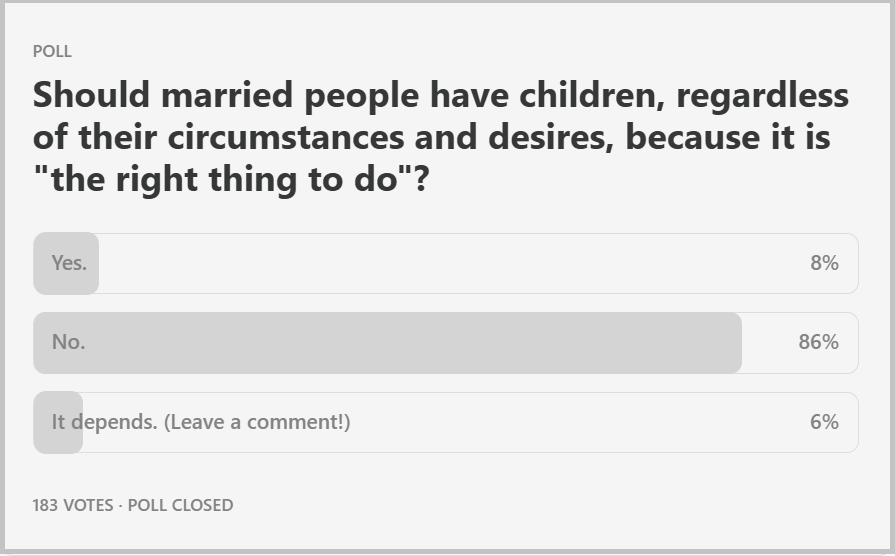
Last Week’s Poll Results:
AWARDS:
Rated “Most Popular Fiction Magazine 2024” by Chill Subs
Rated “Top 10 LitMag of 2023, 2024” by Chill Subs
Rated #1 “The Very Best Literary Magazine” by Ranker
Rated “Top 50 Fiction” on Substack
NEWS:
🤟If you are new to our Substack, take a look at the Welcome Message from our Editor and Founder, Kolby Granville.
🖥️ Want a book club with a focus? We have started a Luma Page for our virtual/zoom and in-person short story discussion groups. Join today!
🆘 Volunteer as an acquisition reader and help us decide which story submissions get published. No experience required, just a keen eye for stories that make you think. If you’re interested, just shoot Kolby an email and he’ll get you set up.
👩🏫 Educators, find out how to get a free copy of a themed edition.
Thanks for reading, sharing, and re-stacking this post!
Maddie
ADVERTISE WITH US
Interested in advertising in this email? Learn more.
What a complex short story. Hobbes-ian indeed.
Some depends on whether the instinct is to freeze or to fight, I think. Either way, it's an "animal"-ish instinct, but the individual inclination changes the way we are willing to interact with others, and a lot of ethics seem to depend on those interactions.